THE ULTIMATE TIRE
PUMP...
Plus some
good
info on making springs,
.... AND A BRO DEAL
How would you like to be able to
make a really superior tire pump?
You can, from the plans offered here.
Pumping up tires by hand is not the most fun thing to do. But if
you ever need to do it, which would you prefer to do it with – a lousy
one that wastes a large percentage of your effort (or may even break,
leaving you without a functioning tire pump, and possibly injure you as
well), or a very efficient pump that you can make yourself, that does
not leak, doesn't waste your energy, and is tougher than the best
factory-made tire pump money can buy?
As I understand it, the U.S. military uses a tire pump that has been
made for them unchanged for the past 65 years. I had been
considering getting one of these pumps – not because I have frequent
use for a tire pump, but because I do need one once in a while, and
because – given that I do – it would appeal to me to have a really good
one.
Then one day, entirely by accident, I spotted a very cool looking tire
pump, and naturally, since I had tire pumps on my mind at the time, it
caught my eye. Because of my interest, the guy who'd made it told
me about it, and even partially dismantled it to show me some of its
details.
( Click on the picture to see a
larger version. )
(NOTE: The hose/T-fitting/pressure gage is unscrewed
from the base of the tire pump in this photo.)
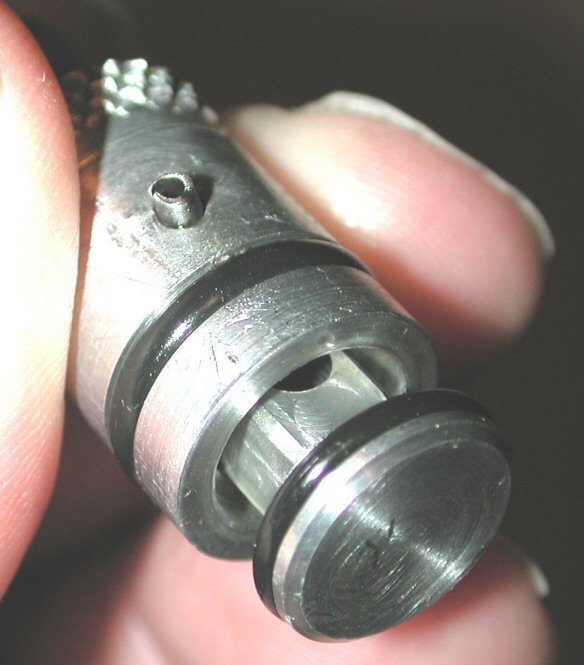
The piston in this pump is more efficient than the usual leather
cup seal.
Leather is almost ideal for the purpose, because it is very durable,
and it retains oil, but it is porous, so it wastes some of your effort
in unavoidable leakage. This guy's piston solves this problem
100%. It also incorporates a simple but efficient shop-made air
inlet valve, so that when you raise the plunger rod, new air is let
into the pump very readily. When you start your compression
stroke, the inlet valve closes, with no leakage, so the new batch of
air gets compressed and sent to your tire, rather than leaking back
past the inlet valve or a porous cup leather.
All the parts in this guy's pump were either cheap to buy, or were
readily made by any machinist from easy-to-get materials.
A standard brass reducer fitting at the base of the pump is bored out
to hold a simple, slick, and very efficient shop-made check
valve. Immediately downstream from the check valve/reducer
fitting is a T-fitting carrying an oil filled pressure gauge. I
thought that would be serious money, but it turns out it only costs
about $12. (Normally, it'd be more than that, but I set up something to
save you some money – see below.)
Above is a close-up of the little
check valve.
( Click on the picture to see a larger version. )
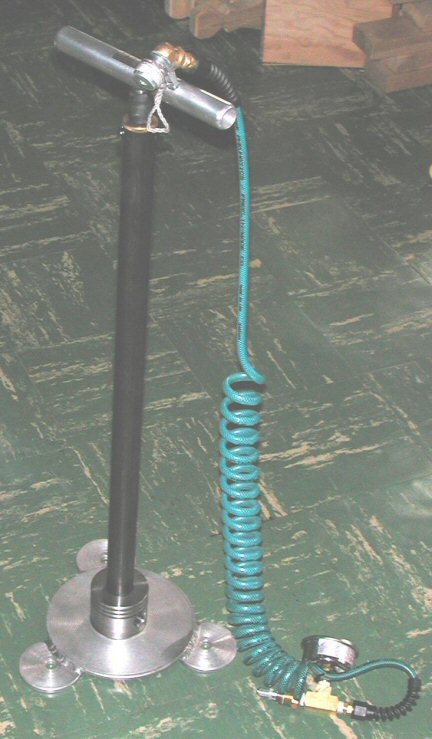
Most hand operated tire pumps are very easily knocked over, because
they are tall, top-heavy and have a small base. Not this one – it
has a base on it that overcomes this problem. If you give it a
bump, it cockles around a little, and returns to upright. Note,
however, that if you want to stow the pump in your vehicle, you can
remove this base very readily
by undoing one bolt.
In short, this guy had made a real serious tire pump.
He loaned it to me, and gave me a free hand to dismantle it and measure
everything. I did so, and when I had figured out the last detail,
I worked up good drawings, and then started gathering materials to make
one for myself. I think I am going to have the best tire pump
imaginable.
I also got his ok to offer my drawings and how-to notes for sale, so
you too can build a really good tire pump – it's easy to do, you'll
learn some interesting things along the way, and when you're done,
you'll have a tire pump that probably even beats the mil-spec one Uncle
Sam uses.
A BONUS:
Some
info on making Springs
Also included with these
plans is some excellent info
on spring making,
including how to calculate mandrel diameter required to produce a coil
spring of a given size, using wire of a given size.
And a BRO DEAL
I set up a bro deal for my "tire pump guys" so you can pick up the
phone and get a good price for the pressure gage, the coil hose, and
the fitting that clamps onto your tire's valve stem. There's
nothing in this for me, but it'll save you about $16 off the total
you'd normally pay on these three items, if you walked in off the
street
and got the "cash-sale/too-bad-you-don't-have-an-account-here" price.
Tire
Pump Plans (Dimensioned drawings and How-To notes):
US customers: US $15
Canadian and Off-shore customers: Cdn$17
NOTE: With the drawings
and How-To text you will get a password to get into a special part of
my web site where you can see about 30 (downloadable) photos of the
tire pump and its components. This way, you get to see nice clear
color pictures instead of not-so-nice photocopied black-and-white
ones. (And if you are really keen to see the photos before you
order the plans, e-mail me from my home page, and I'll tell you how to
get at them.)
Please
click here to go back to my home page